


You can’t schedule a breakthrough.
Roadmaps are designed to align teams and drive execution. Traditionally, they answered one question: What will be delivered by when?
Today, many organizations use outcome-driven roadmaps — focused on impact rather than features. A meaningful step forward. But even outcome-driven roadmaps are still instruments of execution. They optimize toward defined objectives and assumed directions.
Innovation begins earlier. Before the outcome is defined and the metrics are known.
It begins with uncertainty and exploration. With the question: What if…?
This is where organizations get stuck. They want innovation — but their operating model is built primarily for execution. And execution is hungry. It consumes time, talent, and unprotected ideas. The system is optimized for today — not tomorrow.
Common Reasons Why Innovation Fails
Organizations optimized for execution unintentionally suppress exploration. Their systems reward predictability, efficiency, and delivery — not discovery.
Three patterns come up repeatedly:
Execution consumes all capacity. Roadmaps, targets, and operational pressure expand to fill every available hour. Exploration becomes something to do later, when things calm down. In reality, later never comes.
Innovation becomes an event. Hackathons and idea days create real energy. People get excited, ideas flow, and for a moment it feels like anything is possible. Then Monday arrives. Without a continuation plan, ideas fade and everyone returns to their real work. Until the next hackathon.
Innovation gets detached from reality. Innovation labs and dedicated task forces are a genuine step forward. But the real risk is drifting too far from real users and real constraints. They produce interesting concepts that struggle to land back in the core product. The ideas can be good. The distance is what makes them impractical.
In all three cases, innovation isn’t rejected. It just doesn’t have enough space — or structure — to survive.
The Innovation Track
An Innovation Track is a deliberately protected space alongside your delivery roadmap — designed for exploration, not execution.
It exists to investigate opportunities that don’t yet fit into quarterly targets, but could materially shape the future of the business. It may explore emerging technologies, new customer segments, new value propositions, or shifts in the business model itself.
Its purpose is simple: test what might matter next — before committing the organization to build it.
It is time-bound, hypothesis-driven, and importantly, focused on real problems. It’s a structured way to reduce uncertainty before an idea enters the roadmap.
What Makes It Work
A small, focused, startup-like container inside your company — built to explore one meaningful opportunity with intention. An effective Innovation Track has three key components: a clear charter, the right people, and a deliberate time window.
The Charter
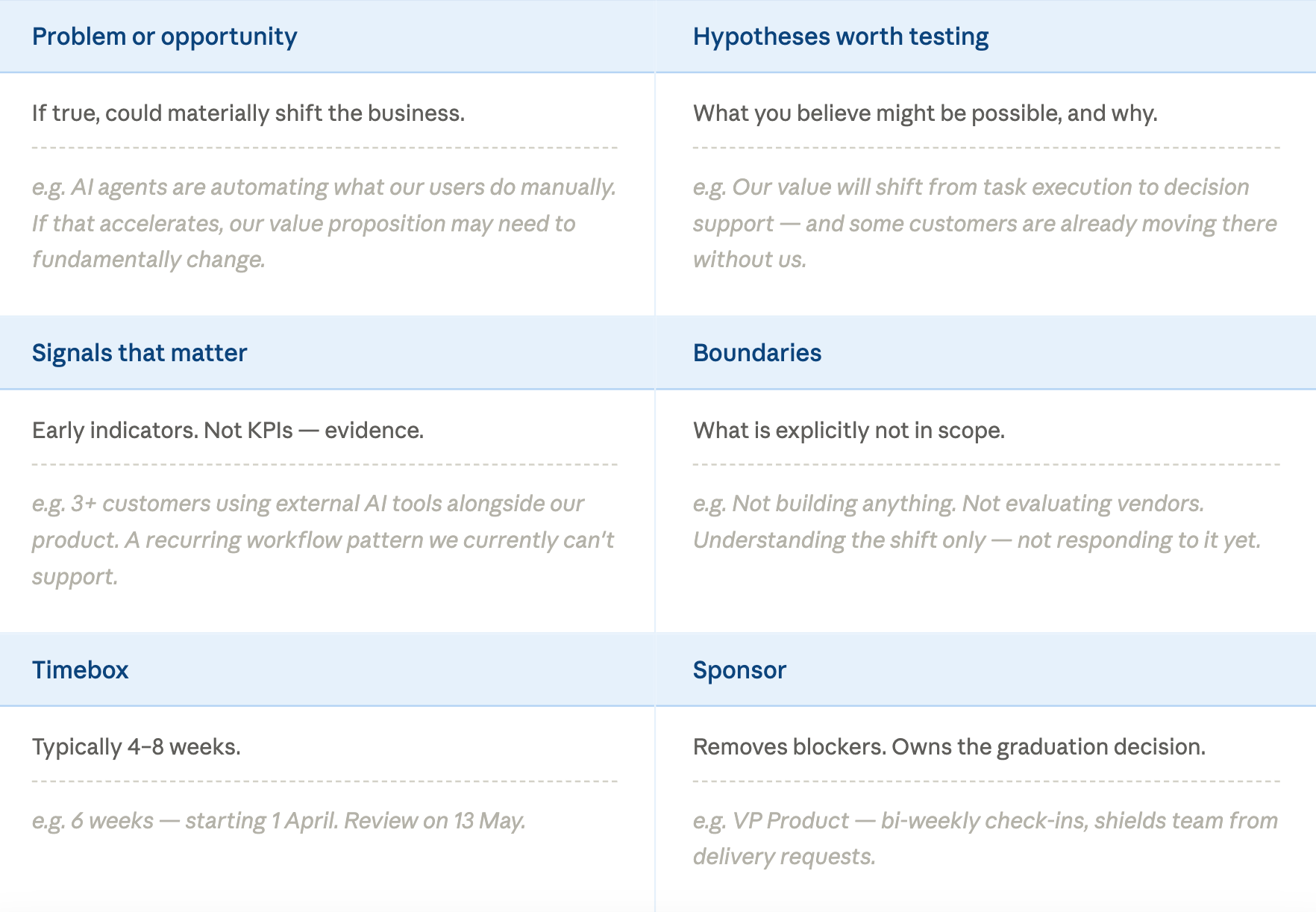
A charter is a simple one-pager that sets direction without prescribing output. It should capture:
The Team
Innovation doesn’t require a large team. In fact, small team learns much faster. The ideal setup looks like a startup founding team: 1–3 people, cross-functional by default, empowered to decide without permission, and connected to real users.
Small, sharp, and autonomous. That’s the formula.
The Time Window
Innovation Tracks are intentionally short. Four to eight weeks is the typical window — long enough to learn something real, short enough to avoid drifting. The expected outcome isn’t a polished feature. It’s a decision: do we continue, pivot, or stop?
Protecting the Track Without Isolating It
An Innovation Track only works if the team can explore freely — without being pulled in day-to-day execution. But there’s an equally dangerous failure mode: complete isolation so that the work loses touch with reality.
The art is in building a protective bubble with a door.
Protected from delivery pressure. No sprint commitments. No last-minute requests. The team needs to be temporarily removed from the urgent dealines so they can think clearly and be creative.
Stay connected to the real world. Exploration without grounding becomes fantasy. The team must have access to engineering realities, domain expertise, business stakeholders or real users. This is what keeps the Track connected to the real world.
Join only the rituals that matter. Monthly demos to share learning. A regular check-in with the sponsor. Visible to the organization — but not interrupted by it.
Make expectations explicit. Everyone around the Track should know what the team is working on, how long it runs, and why they aren’t available for delivery work. Clarity protects the team better than isolation.
Governance: Keeping It Light
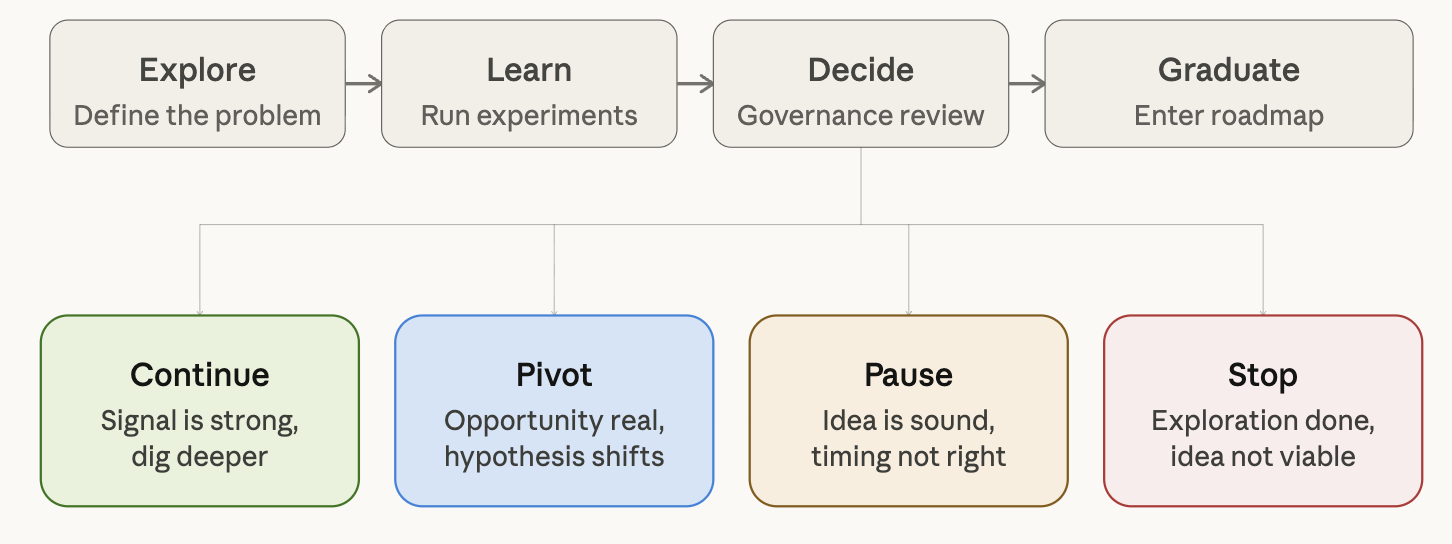
At the end of every cycle, gather the team, the sponsor, and a few key stakeholders. The question on the table is straightforward: what did we learn, and what does that learning mean?
The conversation centres on three things: the story of the work, the strength of the signal, and the path forward. The decision itself is:
Continue — the signal is promising enough to dig deeper.
Pivot — the opportunity still feels real, but the hypothesis needs to shift.
Pause — the idea is sound, but timing or dependencies aren’t right.
Stop — the exploration served its purpose. But the idea isn’t worth pursuing further.
From Exploration to the Roadmap
Graduation is the moment an idea stops being a possibility and starts becoming a plan. An Innovation Track should never drift into delivery by accident — graduation is a conscious, evidence-based step.
A Track is ready to graduate when three things are true:
there is a real signal (not a perfect metric, but enough evidence to believe the opportunity is meaningful),
the idea is buildable (the team understands feasibility well enough to move into structured experimentation), and
there is a value case (you know who benefits, how, and why it matters).
From there, the work becomes more tangible. It’s not yet time for full delivery, but for more structure than exploration. The team defines the smallest meaningful version, builds early prototypes, validates core assumptions with real users, and identifies early risks.
Once that work shows consistent value, the idea is ready for the roadmap: ownership defined, scope agreed, investment committed. Good graduation is about commitment informed by evidence.
How to Start in 2 Weeks
Getting started doesn’t require a special team, a new budget cycle, or a grand announcement. You can launch your first Innovation Track in two weeks — with the people and knowledge you already have.
Step 1 — Pick the opportunity. One problem or emerging question that keeps resurfacing. The kind of thing people say “we should look into this” about, but never do. Frame it as a question worth exploring, not a solution to build.
Step 2 — Form the team. Identify 1–3 curious, cross-functional people. Not the busiest — the most motivated. Nominate a sponsor who will protect the team and own the graduation decision.
Step 3 — Write the charter. One page. The problem, your hypotheses, the signals you’re looking for, the boundaries, and the timebox. Do it together in a single session. That conversation is the first act of exploration.
Step 4 — Set the conditions. Give the team temporary protection from delivery work. Make expectations explicit to everyone around them — what they’re working on, how long it runs, and why they aren’t available for other requests.
Step 5 — Start exploring. Let the team run. Talk to customers, review data, test early assumptions. The goal isn’t a polished output — it’s to start reducing uncertainty.
The first governance conversation happens at the end of the cycle, 4–8 weeks in. That’s when you decide what comes next.
The Real Question
Innovation thrives in a space that is intentional, protected, and connected — where ideas can be tested without pressure, explored without drifting, and evaluated with evidence.
The organizations that sustain innovation through scale aren’t the ones with the best ideas. They’re the ones that built systems where good ideas can survive long enough to become something.
The roadmap will always be there. Execution will always feel urgent. The question for every product and tech leader is whether they’ve built anything to protect the space before the roadmap — the uncertain, generative space where the next version of the company is beginning to take shape.
Enjoyed this read? Subscribe to Lean Product Growth for regular updates on building and scaling a successful product organization.